
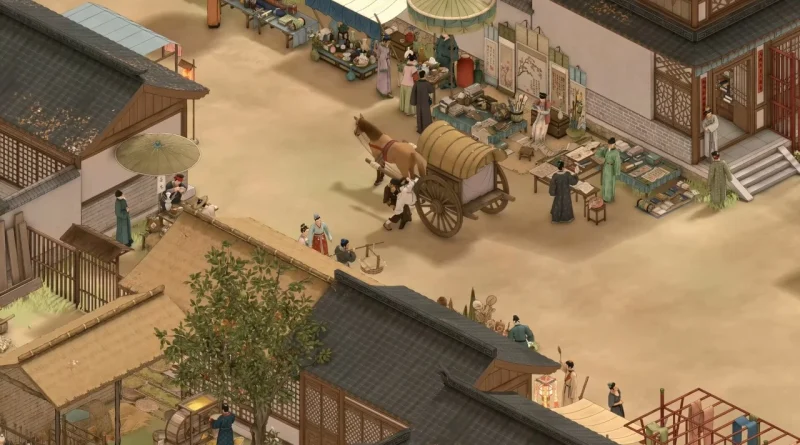
The Bustling World: Developers Reimagine Life Simulation Genre Through the Lens of Ancient China
In an increasingly crowded market of life simulation games, a new title is emerging that promises to fundamentally challenge how players experience the genre. The Bustling World, an ambitious project currently in development, aims to transport players to ancient China while simultaneously revolutionizing the core mechanics that have defined life simulators for decades. Rather than relying on the familiar formula of accumulating wealth, maximizing statistics, and grinding through repetitive tasks, the developers are crafting an experience where quality of gameplay takes precedence over numerical progression.
The Evolution of Life Simulation Games
The life simulation genre has deep roots in gaming history, stretching back to titles like The Sims, which first launched in 2000 and went on to become one of the best-selling video game franchises of all time. Over the years, the genre has evolved to include farming simulators like Stardew Valley, social simulations like Animal Crossing, and countless mobile games that often rely on addictive mechanics tied to numerical growth. However, critics have long argued that many modern entries in the genre have become overly focused on metrics, achievements, and progression systems that can feel hollow after extended play sessions. The Bustling World appears to be a direct response to this criticism, positioning itself as a more thoughtful and immersive alternative.
A Philosophy-Driven Approach to Game Design
The Bustling World distinguishes itself through its philosophical stance on game design. According to the developers, the game’s content is naturally integrated into its fundamental mechanics, resulting in what they call a genuinely alive and engaging world. Rather than layering story elements, character interactions, and world-building as separate components on top of gameplay systems, everything has been crafted to feel interconnected and intentional. Players won’t merely be ticking off tasks or watching statistics climb; they’ll be taking part in a dynamic society that reacts to their decisions in substantive ways.
Ancient China as a Rich Historical Backdrop
The choice of ancient China as the setting adds another layer of depth to the project. Chinese history spans thousands of years and includes numerous dynasties, each with distinct cultural practices, architectural styles, social hierarchies, and philosophical traditions. From the philosophical teachings of Confucius and Laozi to the intricate systems of imperial governance, the Tang Dynasty’s golden age of poetry and art to the Song Dynasty’s remarkable technological innovations, there is an extraordinary wealth of material for the developers to draw upon. This historical richness provides an authentic backdrop that could elevate the simulation beyond simple escapism into something genuinely educational and culturally enriching.
Riding the Wave of Interest in Non-Western Settings
The gaming industry has witnessed increasing enthusiasm for titles that delve into non-Western historical settings. Games such as Ghost of Tsushima, which portrayed feudal Japan, proved that players crave experiences that immerse them in underexplored historical eras and cultures. Likewise, the triumph of Chinese-developed games like Genshin Impact and Black Myth: Wukong has demonstrated that an enormous global audience exists for content grounded in Asian mythology and history. The Bustling World seems to be capitalizing on this trend while establishing its own distinctive position in the life simulation space.
Industry analysts have noted that the life simulation genre is ripe for innovation. While franchises like The Sims continue to dominate the market, there has been criticism that recent entries have become too focused on monetization through downloadable content and expansion packs rather than delivering cohesive, complete experiences. Indie developers have stepped in to fill this gap, with titles like Coral Island and Paralives gaining significant attention from players seeking fresh approaches. The Bustling World joins this movement, but distinguishes itself through its unique cultural setting and its explicit rejection of the grind-focused mechanics that have become standard in the genre.
Looking Ahead: A New Direction for the Genre
As development progresses, excitement is mounting among fans who are keen to discover whether The Bustling World can fulfill its ambitious promises. The game represents not merely a new addition to the life simulation genre, but potentially an entirely new direction—one where the journey takes precedence over the destination, and where players can immerse themselves in a richly detailed historical world without feeling burdened by artificial progression systems. Should it succeed, it could motivate other developers to rethink what life simulation games can become, shifting away from addictive number-chasing toward more meaningful and satisfying virtual experiences.