
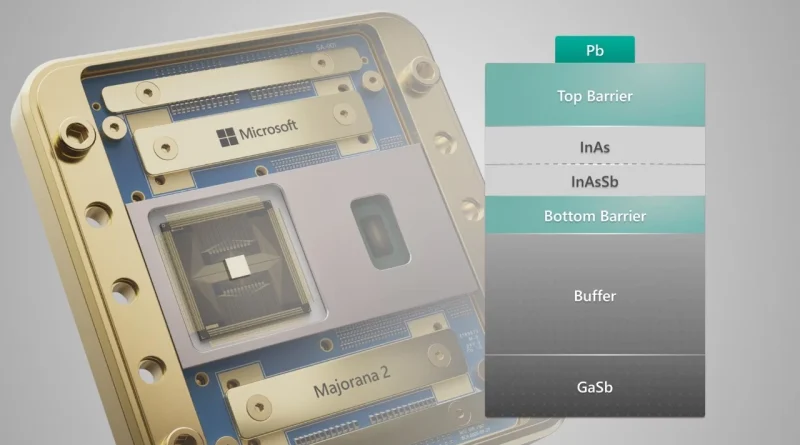
Microsoft Unveils Majorana 2 Quantum Processor with Thousand-Fold Improvement in Qubit Reliability
Microsoft has announced the second generation of its topological quantum processor, named Majorana 2, marking a significant milestone in the race toward practical quantum computing. The technology giant claims that the new chip demonstrates a remarkable thousand-fold improvement in reliability compared to its predecessor, potentially accelerating the timeline for quantum computers that can solve real-world problems beyond the capabilities of classical supercomputers.
Microsoft’s Unconventional Approach to Quantum Computing
The announcement represents a major validation of Microsoft’s unconventional approach to quantum computing. While competitors like IBM, Google, and IonQ have pursued more established qubit technologies such as superconducting circuits and trapped ions, Microsoft has spent over two decades developing topological qubits based on exotic quantum particles called Majorana fermions. These particles, first theorized by Italian physicist Ettore Majorana in 1937, have the unique property of being their own antiparticles, which makes them inherently more resistant to the environmental noise that plagues conventional quantum systems.
The Challenge of Qubit Coherence and Topological Protection
The fundamental challenge in quantum computing lies in maintaining qubit coherence — the delicate quantum states that enable computations far beyond classical capabilities. Traditional qubits are notoriously fragile, requiring near-absolute-zero temperatures and extreme isolation from electromagnetic interference. Even minor disturbances can cause decoherence, destroying the quantum information and introducing errors that accumulate rapidly during calculations. This has led to the development of complex error correction schemes that require thousands of physical qubits to create a single reliable logical qubit, significantly limiting the practical scale of current quantum machines.
Microsoft’s topological approach aims to solve this problem at the hardware level rather than through software-based error correction. By encoding quantum information in the topological properties of Majorana fermions — essentially their spatial arrangement rather than their individual states — the system becomes naturally protected against local perturbations. This concept, known as topological protection, has been compared to the difference between storing information in the shape of a knot versus a fragile glass sculpture. The thousand-fold reliability improvement announced with Majorana 2 suggests that Microsoft’s long-term bet on this technology is finally paying dividends.
Overcoming Early Setbacks
The development comes after years of skepticism from the scientific community regarding Microsoft’s chosen path. In 2018 and 2021, the company faced setbacks when research papers claiming evidence of Majorana particles had to be retracted due to data analysis issues. However, Microsoft persisted with its research program, and in 2023 finally published peer-reviewed evidence confirming the creation of Majorana zero modes in specially engineered semiconductor-superconductor nanowires. The Majorana 2 processor builds upon this foundational breakthrough, transitioning from laboratory demonstrations to an engineered chip architecture.
The Competitive Quantum Computing Landscape
Industry analysts note that the quantum computing landscape remains highly competitive, with different approaches offering various trade-offs between stability, scalability, and operational requirements. IBM recently unveiled its Heron processor and announced plans for systems exceeding 100,000 qubits by 2033. Google’s Sycamore processor famously achieved quantum supremacy in 2019, while startups like IonQ and Rigetti continue advancing trapped ion and superconducting technologies respectively. Microsoft’s topological qubits, if they deliver on their promise of inherent error resistance, could potentially leapfrog these approaches by dramatically reducing the overhead required for fault-tolerant quantum computation.
Practical Applications and Future Outlook
Dependable quantum computers offer practical uses across many fields essential to contemporary society. Drug manufacturers are particularly excited about quantum simulations capable of modeling molecular interactions with unmatched precision, which could transform pharmaceutical development and shrink timelines from decades down to years. Banks and investment firms are pursuing quantum algorithms to optimize portfolios and assess risk. Researchers studying climate change aspire to build more precise atmospheric models, and materials scientists seek to engineer new superconductors and catalysts at the atomic scale. While these applications are mostly theoretical given today’s noisy intermediate-scale quantum devices, breakthroughs such as Majorana 2 are making them increasingly achievable.
Microsoft has not disclosed specific technical specifications or a commercial timeline for systems based on the Majorana 2 architecture. However, the company has previously stated its goal of achieving a quantum supercomputer capable of performing one million reliable quantum operations within the next decade. With this latest announcement, Microsoft reinforces its position as a serious contender in the quantum computing race, demonstrating that its patient, research-intensive approach may ultimately prove more transformative than incremental improvements to conventional qubit technologies. The quantum computing community will be watching closely as further details emerge about Majorana 2’s capabilities and Microsoft’s roadmap toward commercially viable quantum systems.